
New Car vs. Used Car: What the Numbers Actually Say for Family Budgets

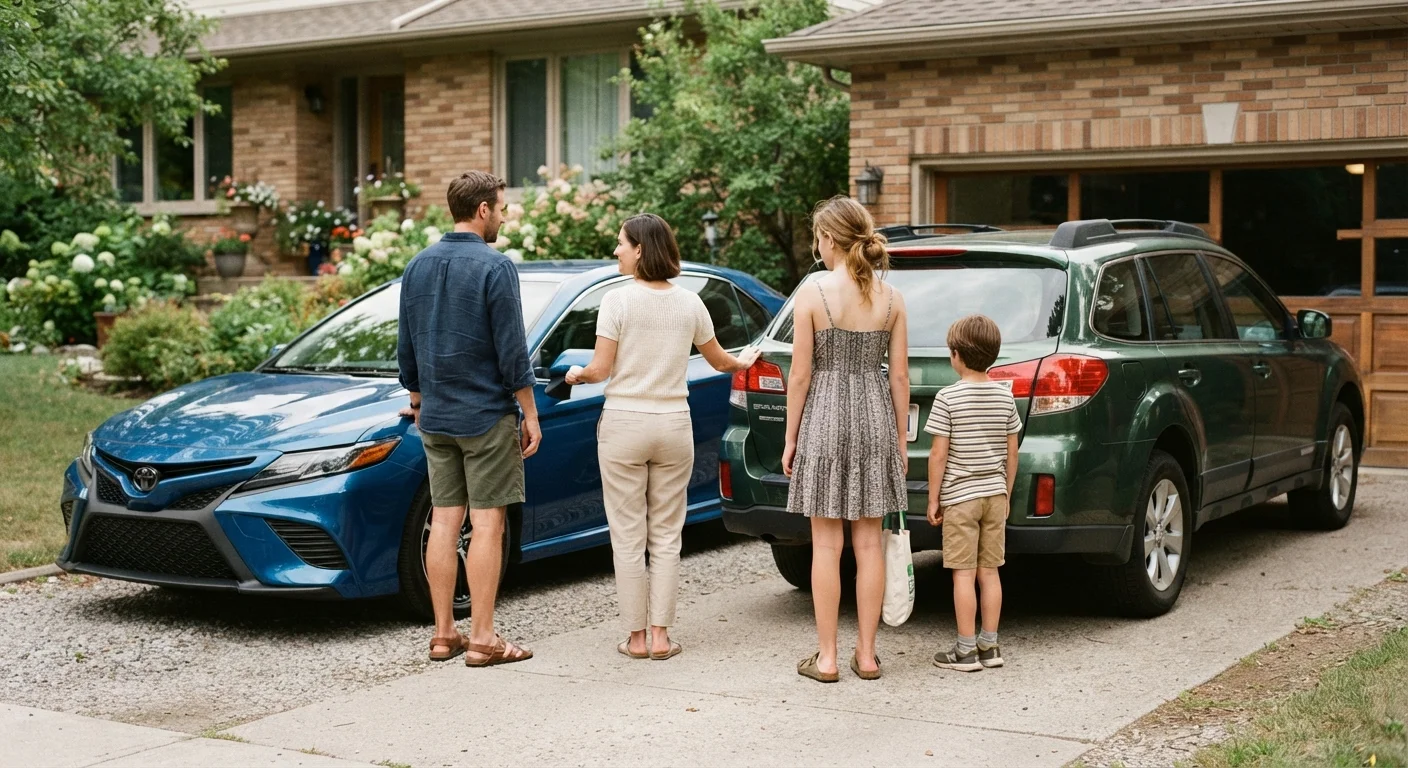
Photo: balancedlivingtools.net editorial
Key Takeaways
- A new car loses roughly 20 percent of its value in the first year of ownership.
- Used cars typically carry higher interest rates on auto loans, which can offset some of the price advantage.
- Certified pre-owned vehicles can bridge the gap between reliability and cost for many families.
- Insurance premiums are generally lower for used vehicles, adding to long-term savings.
- The best choice depends on how long a family plans to keep the vehicle and what financing they can access.
How depreciation actually works against new car buyers
Depreciation is the single largest cost in new car ownership, and it hits hardest in year one. A new vehicle can shed around 15 to 20 percent of its purchase price the moment it leaves the lot, according to data tracked by automotive valuation firms. By the end of the third year, many vehicles have lost 40 to 50 percent of their original value.
When a family buys used, someone else has already absorbed that loss. A three-year-old vehicle with average mileage might be priced at roughly half of what it cost new, yet still have the majority of its mechanical life ahead of it. That gap is where the financial case for buying used is strongest.
For families who plan to sell or trade in within a few years, this matters a great deal. Holding a new car for only three to four years means you are still in the steepest part of the depreciation curve when you try to recoup value. Trade-in negotiations often catch families off guard precisely because they underestimate how much value has already eroded.
| Criterion | New car | Used car |
|---|---|---|
| Purchase price | Higher | Lower (depreciation absorbed) |
| Depreciation rate | Fastest in years 1-3 | Slower, partly absorbed already |
| Typical loan interest rate | Lower (lender and promo rates) | Higher (older collateral) |
| Warranty coverage | Full manufacturer warranty | Limited or none (CPO varies) |
| Insurance cost | Higher premiums | Generally lower premiums |
| Repair risk | Low (covered under warranty) | Higher, rises with mileage |
| Customization options | Full factory options available | Fixed to prior buyer choices |
Financing costs, insurance, and the full monthly picture
The sticker price gap between new and used narrows once financing enters the picture. New cars typically qualify for lower interest rates. Lenders treat new vehicles as lower-risk collateral, and manufacturers sometimes offer promotional rates that used cars cannot access. A family financing a used car at 8 percent versus a new car at 5 percent will pay meaningfully more in interest over a four or five-year loan, even though the principal is smaller.
Insurance premiums tend to run lower on older vehicles because the replacement cost is lower and comprehensive coverage requirements drop as loan-to-value ratios change. For a family carrying full coverage on a new vehicle versus liability-focused coverage on a paid-off used car, the annual insurance difference can reach several hundred dollars. Total annual ownership cost includes these line items, and families who ignore them when comparing sticker prices are comparing incomplete numbers.
Understanding how interest rates and loan terms affect total borrowing cost is worth doing before committing to either path. A longer loan term lowers monthly payments but increases total interest paid, and this math applies to both new and used purchases.
~20%
First-year depreciation on a new vehicle
Automotive valuation data consistently shows new cars lose roughly 15 to 20 percent of their value in the first twelve months of ownership.
40-50%
Value lost by year three on many vehicles
By the end of the third model year, a large share of consumer vehicles have shed nearly half their original purchase price.
1-3%+
Typical interest rate premium on used auto loans
Used vehicle loans commonly carry rates one to three percentage points above comparable new-car financing, according to Federal Reserve consumer credit data.
Maintenance, reliability, and what the warranty actually covers
New cars come with manufacturer warranties, which typically cover the powertrain for five years or 60,000 miles and basic components for three years or 36,000 miles. During that window, major repair costs fall on the manufacturer rather than the family. That is a real financial protection, not a marketing point.
Used vehicles outside warranty coverage shift all repair risk to the owner. Older vehicles with higher mileage are statistically more likely to need repairs, and repair frequency tends to increase after 100,000 miles for most vehicle categories. A family buying a vehicle with 80,000 miles should budget for the possibility of significant maintenance within a few years.
Certified pre-owned programs can reduce but not eliminate this uncertainty. These programs typically require a multi-point inspection and offer a limited powertrain warranty, which gives families more protection than a standard used purchase. The trade-off is a higher price than non-certified used inventory, so the cost advantage over new shrinks somewhat.
Which choice fits a family budget better
No single answer covers every family situation. A household with stable income, a long intended ownership period, and access to good financing may find that a new car's total cost over eight or ten years is not dramatically higher than a comparable used purchase, once warranty savings, lower interest rates, and avoided early repairs are counted.
A family with tighter monthly cash flow, a shorter intended ownership window, or credit conditions that push loan rates upward will generally find that a used vehicle in good condition keeps more money available for other priorities. The broader secondhand-versus-new question follows the same logic in other spending categories: the right answer depends on how long you plan to use the item and what your alternatives cost.
Families can also consider leasing as a third path, though leasing has its own trade-offs around mileage limits and equity that make it a poor fit for high-mileage households.
The clearest decision framework: estimate the total cost of ownership over your likely holding period, not just the monthly payment or the purchase price. Include depreciation, interest, insurance, and expected maintenance. That number, not the lot price, is what the decision should rest on.
The content provided on our blog site traverses numerous categories, offering readers valuable and practical information. Readers can use the editorial team’s research and data to gain more insights into their topics of interest. However, they are requested not to treat the articles as conclusive. The website team cannot be held responsible for differences in data or inaccuracies found across other platforms. Please also note that the site might also miss out on various schemes and offers available that the readers may find more beneficial than the ones we cover.