
Understanding R-Values: What Home Insulation Ratings Actually Mean

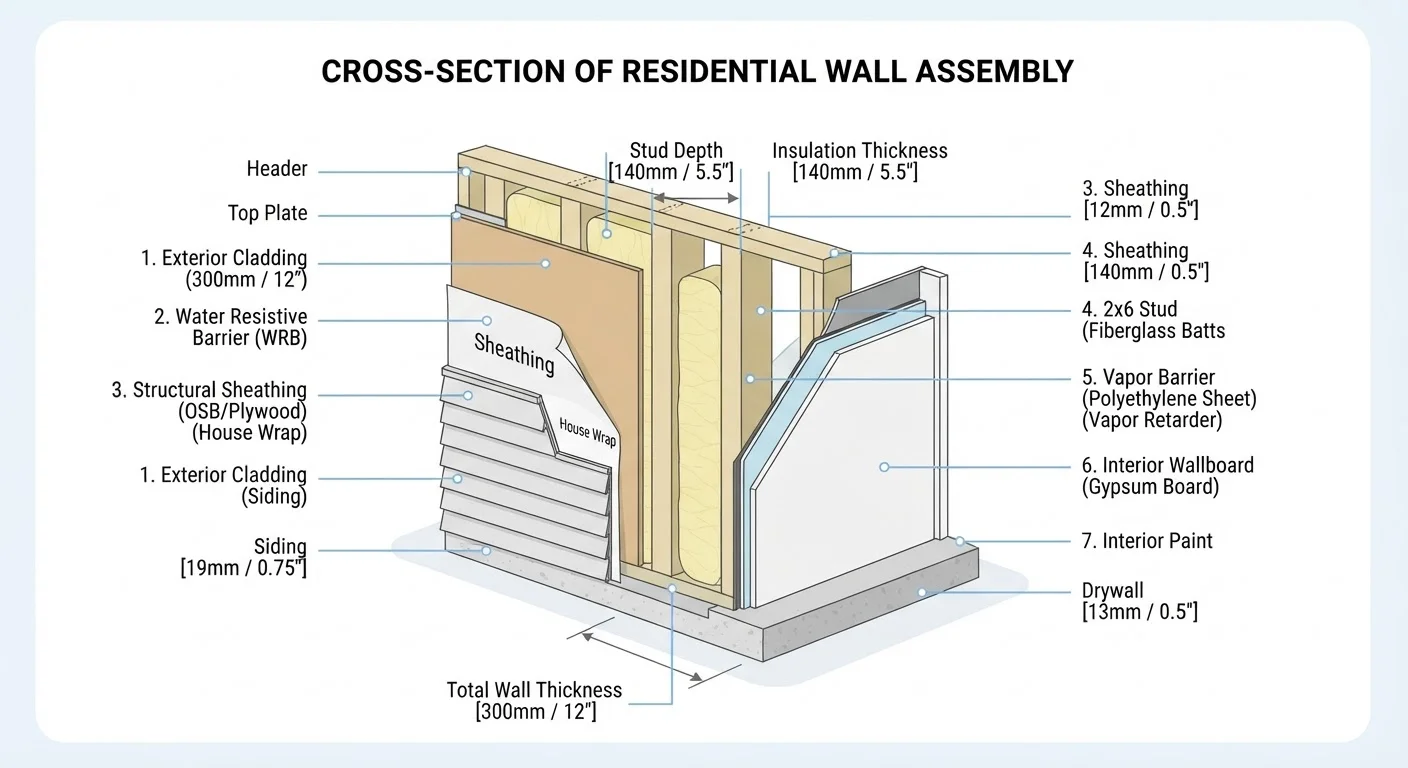
Photo: balancedlivingtools.net editorial
Key Takeaways
- A higher R-value means greater resistance to heat flow and better energy efficiency.
- The appropriate R-value varies by climate zone, building type, and the part of the house being insulated.
- Attics generally require the highest R-values in a home, often R-38 to R-60 in colder climates.
- R-values are additive, so combining insulation layers increases the total resistance.
- Air sealing alongside insulation produces greater efficiency gains than either measure alone.
How R-value is measured and why it matters
Heat moves through building materials continuously, from warmer spaces to cooler ones. In winter, that means heat escapes outward through walls and ceilings. In summer, heat pushes inward. Insulation slows that movement, and R-value is the standard way to measure how effectively it does so.
The R stands for thermal resistance. A material with an R-value of 20 resists heat flow twice as well as one rated R-10. This makes comparisons between insulation types straightforward, even when the materials themselves differ significantly, such as fiberglass batts versus loose-fill cellulose versus rigid foam board.
R-values are measured under controlled laboratory conditions using ASTM International test standards. The number on a product label reflects performance at a standardized mean temperature. Real-world performance can vary based on installation quality, moisture exposure, and whether the insulation is compressed during installation.
R-values are additive across layers
R-values are also additive across layers. If a wall assembly includes R-13 batt insulation in the cavity plus R-5 rigid foam on the exterior, the combined resistance is R-18. This property makes it straightforward to plan upgrades incrementally.
U.S. climate zones and recommended R-values
The U.S. Department of Energy divides the country into eight climate zones, ranging from Zone 1 (hot and humid, such as southern Florida) to Zone 7 (very cold, such as northern Minnesota and Alaska). Recommended R-values increase with zone number because colder regions demand more resistance to prevent heat loss.
As a general reference, the DOE publishes these approximate ranges for existing homes:
- Attic: R-30 to R-60, depending on zone
- Wall cavities (uninsulated): R-13 to R-21
- Floor above unconditioned space: R-13 to R-30
- Crawl space walls: R-5 to R-19
These figures apply to existing homes being upgraded. New construction must meet local building codes, which often exceed minimum DOE recommendations in cold-weather states.
90%
U.S. homes that are under-insulated
The North American Insulation Manufacturers Association has reported that approximately 90% of existing U.S. homes lack adequate insulation and air sealing.
15%
Heating and cooling energy saved by sealing and insulating
The U.S. Department of Energy estimates that typical households can save roughly 15% on heating and cooling costs by air sealing and adding insulation to recommended levels.
Homeowners in mixed climates like Zone 4 (covering much of the mid-Atlantic and parts of the Pacific Northwest) occupy a middle ground where attic insulation of R-38 to R-49 is typically appropriate. The DOE's online zip-code tool lets any homeowner find their specific zone quickly.
Common insulation types and their R-values per inch
Different insulation materials provide different amounts of resistance per inch of thickness. This matters when space is limited, such as inside a 2x4 wall cavity or beneath a floor with shallow joist depth.
Fiberglass batts typically range from about R-2.9 to R-3.8 per inch. Mineral wool (rock wool) batts fall in a similar range. Loose-fill cellulose runs approximately R-3.2 to R-3.8 per inch. Closed-cell spray polyurethane foam reaches R-6 to R-7 per inch, making it the most space-efficient option where depth is constrained. Open-cell spray foam is lower, roughly R-3.5 to R-3.8 per inch.
Rigid foam boards vary by type. Expanded polystyrene (EPS) is around R-4 per inch, extruded polystyrene (XPS) is approximately R-5 per inch, and polyisocyanurate boards can reach R-6.5 per inch at standard temperatures, though performance drops somewhat in very cold conditions.
None of these figures assume perfect installation. Gaps, voids, or compressed batts reduce effective R-value below the labeled rating. A continuous layer of rigid foam board or properly blown loose fill tends to have fewer installation voids than cut-and-fit batts in irregular spaces.
Why air sealing works alongside insulation
R-value measures conductive heat resistance, but homes lose a significant portion of conditioned air through air leaks rather than through the insulation material itself. Common leak points include penetrations for wiring and pipes, recessed light fixtures, attic hatches, and rim joists at the foundation.
The Building Science Corporation, a research organization focused on building performance, has documented that air sealing before adding insulation often produces larger efficiency improvements than insulation alone. Sealing these bypasses with caulk, weatherstripping, or spray foam around penetrations prevents conditioned air from escaping regardless of the insulation R-value installed around it.
Homeowners planning an insulation upgrade should treat air sealing as part of the same project rather than a separate task. In attics, this means sealing around all ceiling penetrations before laying new insulation on top. In rim joist areas, cut-and-cobble rigid foam pieces sealed at the edges address both insulation and air movement simultaneously.
Frequently Asked Questions
The content provided on our blog site traverses numerous categories, offering readers valuable and practical information. Readers can use the editorial team’s research and data to gain more insights into their topics of interest. However, they are requested not to treat the articles as conclusive. The website team cannot be held responsible for differences in data or inaccuracies found across other platforms. Please also note that the site might also miss out on various schemes and offers available that the readers may find more beneficial than the ones we cover.